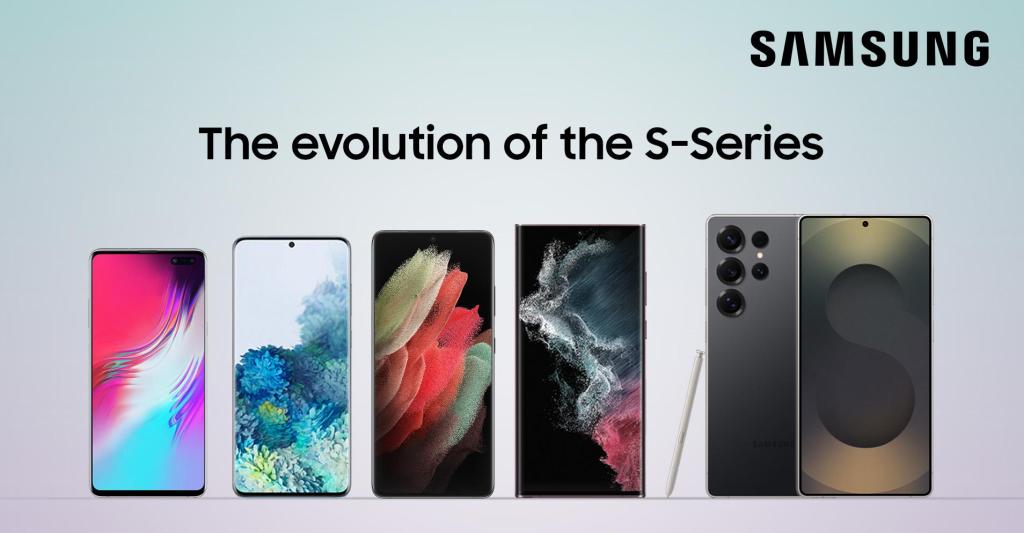
In 2010, Samsung launched a phone that felt like a polished river stone, rounded, plastic and light in the hand.
Sixteen years later, the Galaxy S series has evolved into a titanium-framed, AI-powered device that barely resembles its ancestor. The journey between those two points tells the story of how a smartphone went from luxury accessory to essential daily tool.
The original Galaxy S arrived with a 5MP camera and a Super AMOLED screen that stood out on shelves at the time. It was modest by today’s standards but marked Samsung’s serious entry into smartphone photography.
The S II and S III followed with incremental refinements, slimmer builds, better low-light performance and higher megapixel counts before the S5 in 2014 introduced 4K video and water resistance while keeping the practical removable back.
The first major design shift came in 2015 with the S6 and S6 Edge, when Samsung abandoned plastic for glass and metal and introduced curved edges that gave the phone a seamless, immersive look.
The S8 and S9 pushed that further with near-bezel-less Infinity Displays that wrapped around the sides, while the S10 introduced hole-punch cameras and prismatic glass backs that shifted colour in the light. These were phones designed to be admired.
But as camera hardware grew more ambitious, more sensors, larger megapixels, optical zoom and the elegant curves became a practical problem. The S20 in 2020 was the first to feature a large rectangular camera bump that broke the smooth back and the S21 followed by blending the camera module into the frame itself, introducing matte finishes for better grip and moving toward more neutral tones. Function was beginning to win the argument over form.
By 2022, the S22 had completed the turn to flat screens and boxy aluminium frames, easier to hold, simpler to protect and free of the accidental edge touches that had frustrated users for years.
Individual metal camera rings gave the back a clean, considered look. The S23 refined the formula further with slimmer bezels and the Ultra’s built-in S Pen slot, while the S24 introduced titanium on the Ultra for strength without added weight.
The S25 series, launched in 2025, built on that foundation with subtle but meaningful changes. The Ultra gained more rounded corners for comfort during long use, while the base S25 and S25+ became slightly thinner and lighter.
On the camera side, the Ultra’s ultra-wide lens jumped from 12MP to 50MP, sitting alongside the 200MP main sensor for sharper detail and improved low-light performance.
Taken together, the 16-year arc of the Galaxy S series reflects something broader than product development. Each design decision, the move from plastic to glass, from curved to flat, from smooth backs to structured camera systems was driven by how people were actually using their phones. The result is a device that has traded elegance for utility and in doing so, become far more useful.
 MzuQa
MzuQa 
Leave a comment